Kitchen Storage Planning
The most useful corner cabinet storage solution is the one that brings stored items into view without blocking nearby drawers, appliances, or cabinet doors. Lazy Susans suit everyday cookware, blind-corner pull-outs improve access through a narrow opening, and corner drawers work best when they are planned as part of new cabinetry.
Do not choose hardware by appearance alone. Cabinet type, door opening, interior dimensions, hinge position, load capacity, adjacent handles, and the items you plan to store all determine whether a corner accessory will operate properly.
Choose by access. A corner cabinet can prioritize maximum capacity, easy reach, or uninterrupted drawer storage, but rarely all three at once. Rotating shelves preserve much of the corner volume, pull-out systems bring contents toward the user, and corner drawers divide the space into accessible layers. Measure the actual cabinet opening and test nearby clearances before ordering any mechanism.
Which Corner Cabinet Storage Solution Works Best?
A lazy Susan is often the most practical choice for an L-shaped base cabinet because the rotating shelves keep pots, mixing bowls, and small appliances visible. A blind-corner pull-out is more appropriate when the cabinet extends behind an adjacent run and can be reached only through one narrow door. Corner drawers offer the clearest access but usually require purpose-built cabinetry rather than a simple accessory retrofit.
The decision should start with the cabinet geometry. A diagonal corner cabinet presents a broad angled opening, while a blind corner has storage hidden behind the neighboring cabinet. Hardware designed for one configuration may not fit or move correctly in another.
During a full remodel, custom kitchen cabinet storage solutions can be coordinated with appliance widths, aisle clearances, countertop seams, and cabinet door swings. In an existing kitchen, the realistic choice is limited by the current face frame, hinges, shelf supports, plumbing, and available opening.
Rotating shelves
Lazy Susans provide simple circular access and retain considerable cabinet capacity. They work well for medium-size cookware but leave triangular gaps around the round shelves.
Blind-corner pull-outs
Pivoting or sliding trays bring hidden storage through the door opening. Access improves significantly, although the mechanism occupies part of the cabinet interior.
Corner drawers
Full-extension drawers organize the corner in visible layers. They require precise cabinet construction and use more hardware than a fixed shelf or basic rotating system.
Lazy Susans for L-Shaped and Diagonal Corner Cabinets
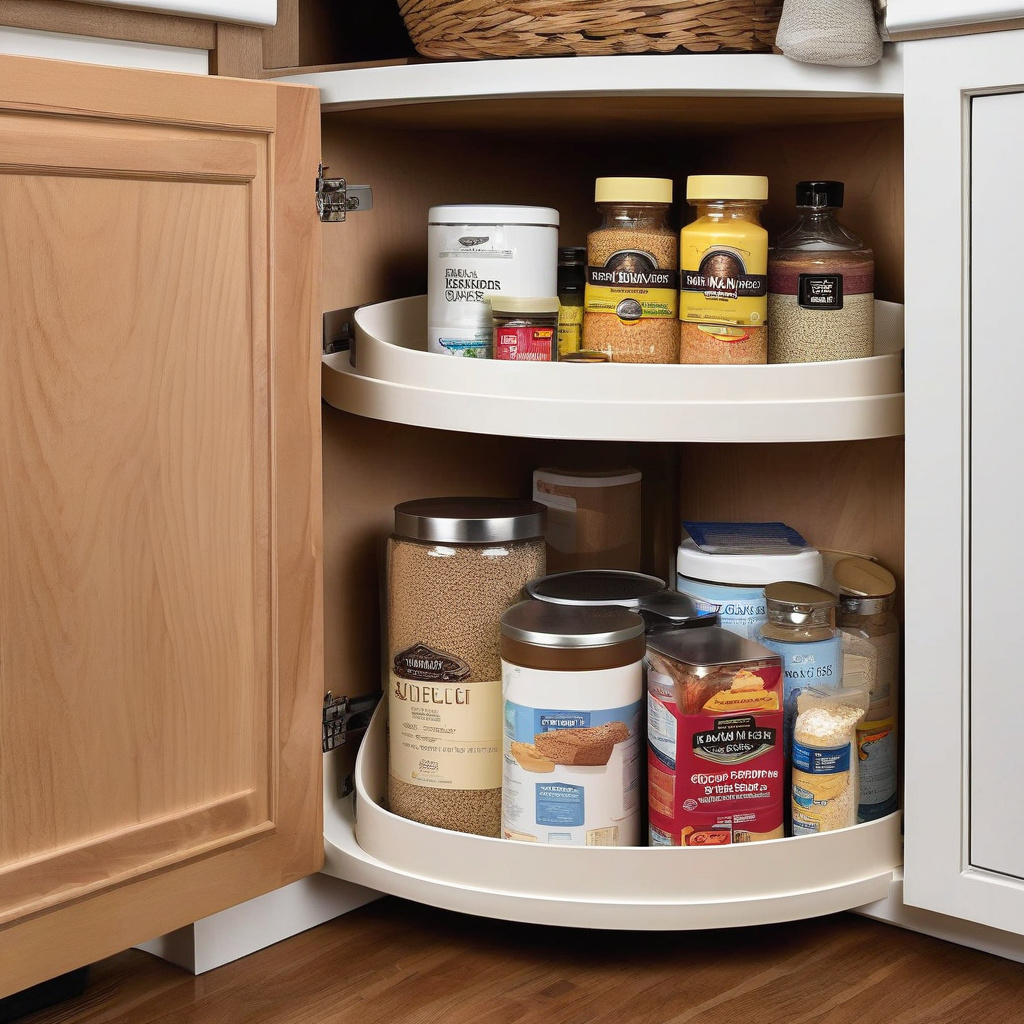
Lazy Susans use one or more rotating trays mounted around a central post or supported by the cabinet structure. Full-circle shelves are typically associated with diagonal corner cabinets, while pie-cut and kidney-shaped versions are designed around particular door and hinge arrangements. The shelf shape must match the cabinet configuration.
The main advantage is predictable access. Turning the shelf brings stored items to the opening, so users do not need to reach into the deepest part of the cabinet. This makes rotating systems useful for pots, bowls, food containers, and appliances that fit securely within the shelf boundary.
Round shelves do not use every inch of a square cabinet, and tall items can tip if they extend beyond the tray edge. Small packages may also slide into gaps unless the shelf has a raised rim. Before choosing a model, verify shelf diameter, mounting height, door attachment, weight rating, and whether the shelves can be adjusted independently.
What to measure before buying corner hardware
- Clear width and height of the cabinet door opening.
- Interior depth from the face frame to the back panels.
- Distance between hinges, shelves, pipes, and support posts.
- Clearance needed for adjacent drawers and cabinet handles.
- Maximum height and weight of the items you plan to store.
Pull-Out Systems for Blind Corner Cabinets
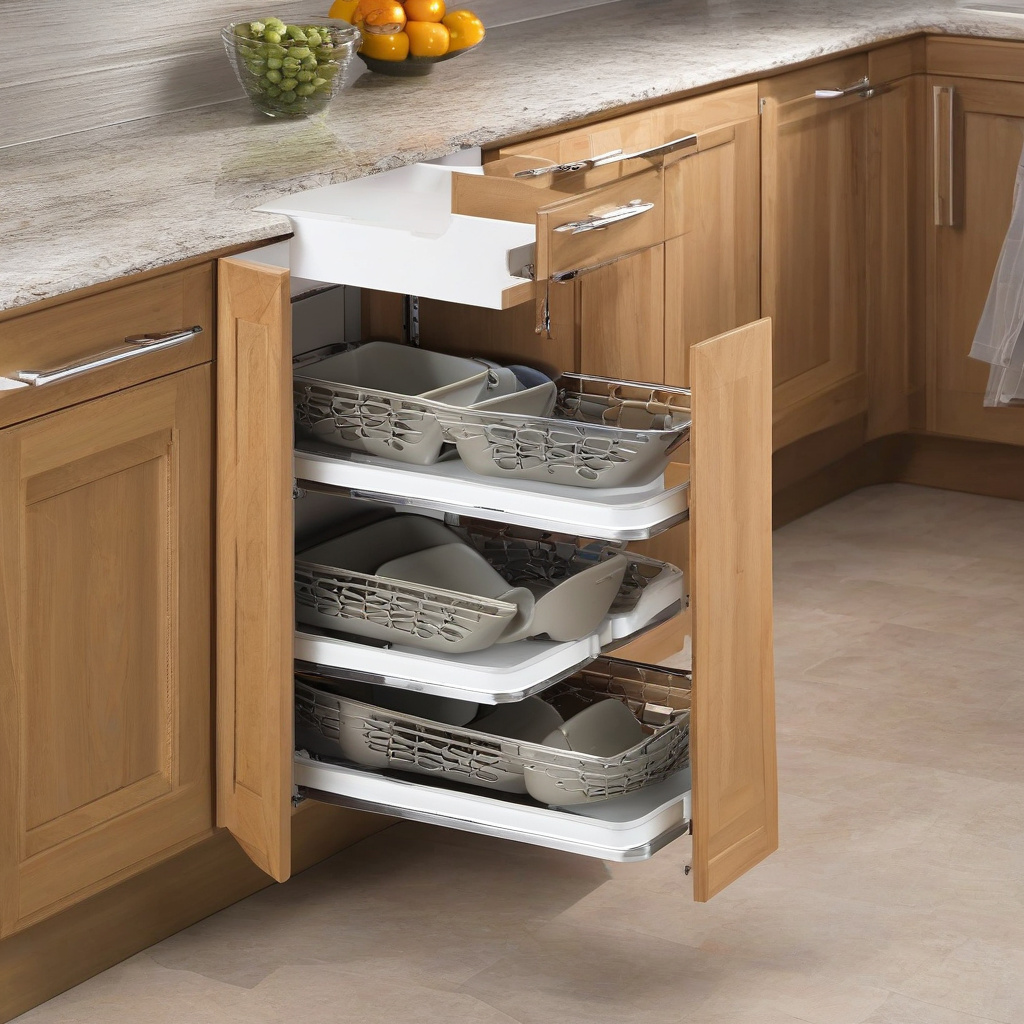
A blind corner forms when one cabinet continues behind the cabinet beside it, leaving a deep section that cannot be reached directly from the front. A pull-out system addresses this problem with trays that slide, pivot, or swing through the available door opening.
Some mechanisms bring the front trays outward first and then move the rear trays into the opening. Others use individually pivoting shelves that sweep around the cabinet frame. These systems provide better visibility than fixed shelves, but their frames and movement paths reduce some usable volume.
Opening width is often the limiting measurement. A cabinet may contain ample interior space yet have a face frame or narrow door that prevents a particular pull-out from passing through. Left-hand and right-hand orientations also matter because the blind section may extend in either direction.
Pull-outs are most useful for items that would otherwise remain forgotten in the back of the cabinet. Store frequently used cookware on the easiest tray and reserve deeper positions for lighter or occasional items. Additional cabinet accessories for organized kitchens should be selected only after the main corner mechanism and its movement path are established.
Practical note: The largest mechanism that fits inside the cabinet is not necessarily the best choice. A system must also pass through the opening, clear the hinges, avoid neighboring handles, and remain serviceable after the countertop is installed.
Corner Drawers Versus Traditional Corner Cabinets
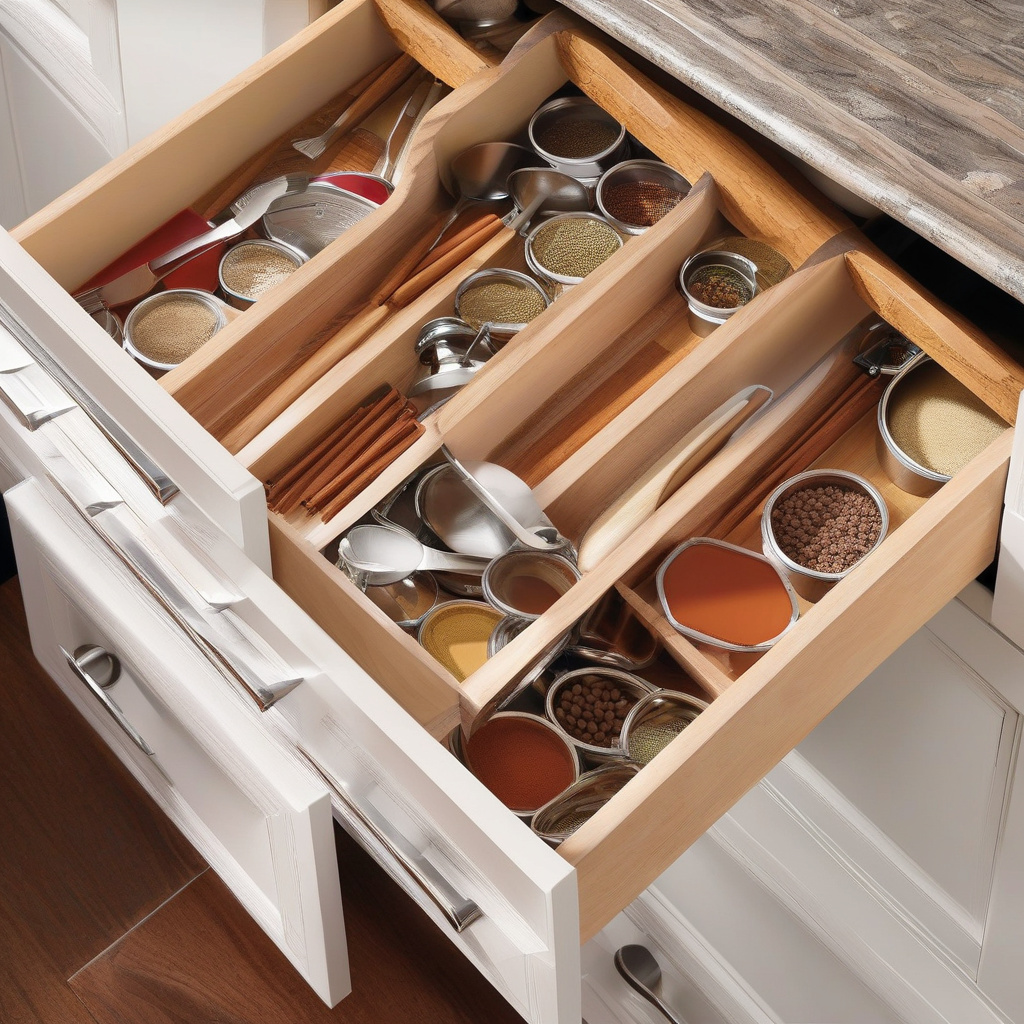
Corner drawers use angled or L-shaped drawer boxes that extend from the corner as individual storage levels. Their primary benefit is visibility: each drawer opens toward the user, and contents can be organized with dividers rather than stacked behind one another.
They are especially effective for utensils, food-storage containers, wraps, linens, and smaller cookware. Deep corner drawers can hold larger items, but the drawer-bottom shape may be less efficient for wide rectangular appliances. Internal dividers should follow the actual drawer geometry rather than assuming a standard rectangular box.
Corner drawers generally make the most sense in new cabinetry because the cabinet carcass, drawer fronts, runners, and surrounding units must be designed as one system. Retrofitting them into a conventional blind or diagonal cabinet usually requires rebuilding more than the interior shelf arrangement.
Keep the existing cabinet
A compatible lazy Susan or pull-out may improve access without replacing the cabinet box, countertop, or neighboring units. This approach is practical when the cabinet is structurally sound and its opening fits available hardware.
Redesign the corner
Corner drawers or a different cabinet configuration may be more effective when the existing opening is too narrow, the cabinet is damaged, or a full kitchen remodel already includes new cabinetry and countertops.
Fixed Shelves, Angled Shelves, and Open Corner Storage
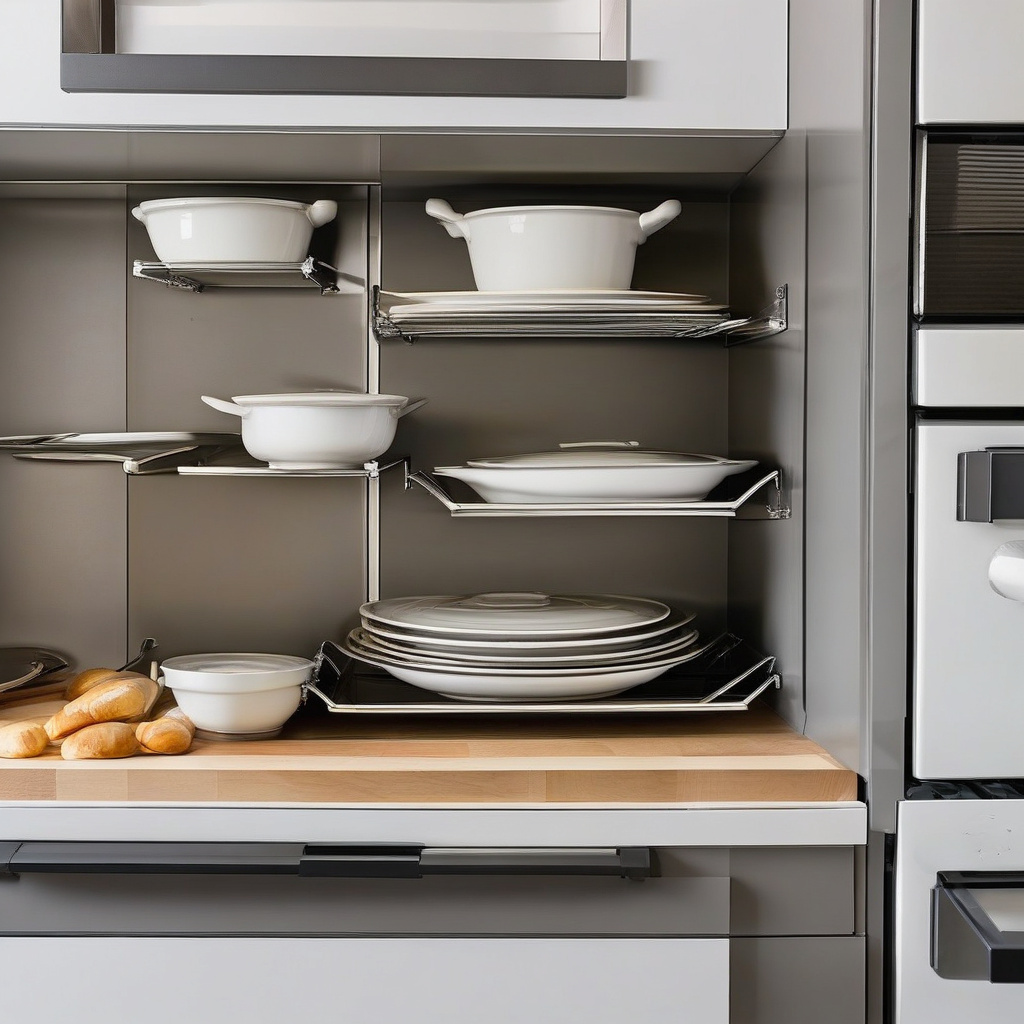
Not every corner needs a complex mechanism. Fixed L-shaped shelves preserve interior volume and have no moving parts, making them suitable for large, lightweight items that are used infrequently. The drawback is limited visibility and a long reach into the back section.
Angled shelves can improve access in diagonal cabinets by creating a wider front edge and shallower rear zone. They work well for serving pieces, mixing bowls, and appliances that can be lifted out through the door opening. Shelf spacing should be planned around actual items rather than divided evenly by default.
An open corner shelf can prevent upper cabinets from creating a heavy visual block near a window or doorway, but exposed storage requires regular cleaning and careful organization. The decision between enclosed storage and display space is explored further in the comparison of open shelves and upper cabinets.
Open shelving is not an equivalent replacement for a high-capacity base corner cabinet. It is most useful for a small group of attractive, frequently used items rather than bulk pantry goods or mismatched cookware.
Corner Storage Options Compared
Each option trades some cabinet volume, hardware complexity, or accessibility for another benefit. The following comparison helps narrow the choice before checking manufacturer-specific dimensions.
| Storage option | Best fit | Main trade-off |
|---|---|---|
| Full-circle lazy Susan | Diagonal corner cabinet with a broad opening | Round shelves leave unused space at the cabinet corners |
| Pie-cut rotating shelf | L-shaped cabinet with folding corner doors | Door alignment and hinge movement must remain precise |
| Blind-corner pull-out | Deep cabinet reached through one narrow opening | Frame and movement hardware consume interior capacity |
| Swing-out shelf | Cookware that benefits from full front access | Requires clear floor and door space while extended |
| Corner drawers | New custom or semi-custom cabinet layouts | More complex cabinetry and shaped drawer interiors |
| Fixed angled shelves | Simple storage for large occasional-use items | Rear contents remain harder to see and reach |
What Should You Store in a Corner Cabinet?
Match the contents to the mechanism. Rotating shelves work best when objects remain stable while the tray turns. Mixing bowls, pots, colanders, food-storage containers, and compact appliances are usually easier to manage than narrow bottles or loosely stacked packages.
Pull-outs are useful for items that benefit from full visibility, including pans, lids, baking equipment, and pantry containers. Respect the stated load capacity and distribute weight instead of placing every heavy appliance on one moving tray. Hardware can bind or wear prematurely when overloaded or installed out of level.
Fixed deep shelves are better for lightweight serving pieces or seasonal equipment than for small everyday items. Storing dozens of loose objects in a blind corner recreates the original access problem even when the cabinet has considerable capacity.
Use bins or dividers only when they can be removed without obstructing the mechanism. A container that fits on the shelf while stationary may strike the door, center post, or frame as the system rotates.
What Affects the Cost of a Corner Cabinet Upgrade?
A basic rotating shelf and a multi-stage blind-corner pull-out involve different amounts of hardware, installation labor, and cabinet modification. Cost also changes depending on whether the accessory fits an existing cabinet or requires new doors, shelves, hinges, drawer fronts, or cabinet boxes.
- Type and condition of the existing corner cabinet.
- Door-opening width and compatibility with available hardware.
- Number of trays, slides, pivots, and soft-close components.
- Need to relocate hinges, shelves, plumbing, or electrical lines.
- Custom cabinet construction, finish matching, and countertop impact.
A retrofit is most predictable when a manufacturer lists the required opening, cabinet depth, interior height, orientation, and load limits for the chosen accessory. Custom alteration becomes more likely when the cabinet is nonstandard or has been modified during an earlier renovation.
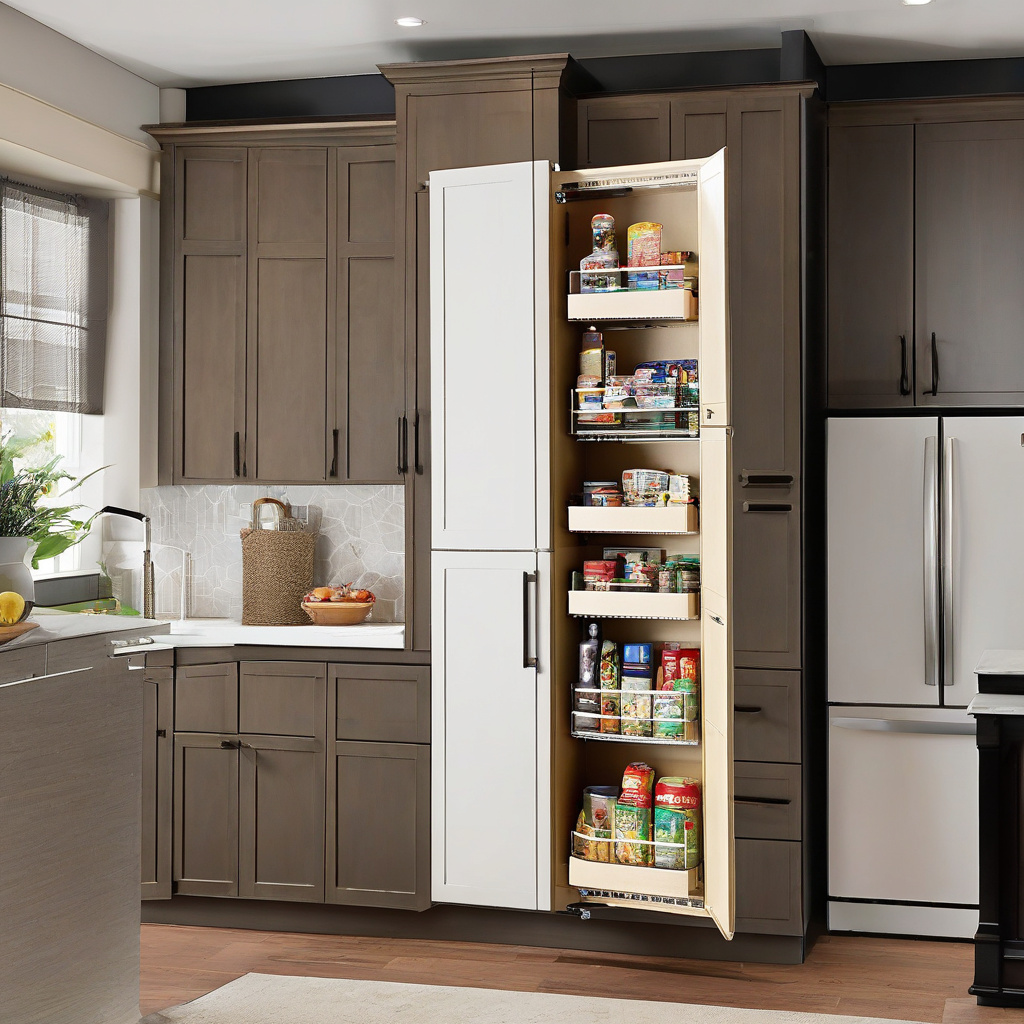
Corner storage should also be considered within the broader plan for hidden kitchen storage ideas. It may be more efficient to redistribute some items to wide drawers, pantry pull-outs, or appliance garages instead of forcing every storage need into the corner.
Common Corner Cabinet Planning Mistakes
The first mistake is measuring the cabinet exterior instead of the clear opening. Face frames, hinges, door thickness, and shelf supports can reduce the usable width enough to prevent a pull-out from operating.
Another error is ignoring collisions. A corner door may open into a dishwasher handle, range, drawer pull, or perpendicular cabinet. Pull-out trays also need space in front of the cabinet, which can be limited in narrow galley kitchens or around an island.
Choosing storage before deciding what belongs in the cabinet can lead to poor results. A shallow rotating tray may be convenient but unsuitable for a large mixer, while a deep fixed shelf may hold the mixer but make smaller items inaccessible.
Do not assume that every mechanism can be installed after the countertop and sink are in place. Some systems require access for mounting, adjustment, or replacement parts. Plumbing in a corner sink base can also eliminate the space needed for storage hardware.
Finally, avoid filling every shelf to its maximum capacity. A kitchen stays easier to use when frequently handled items have visible, dedicated positions. That principle is central to a clutter-free kitchen design, especially when deep cabinets would otherwise encourage forgotten storage.
When Custom Cabinetry Is More Practical
A ready-made accessory may be sufficient when the cabinet box is square, sound, and close to standard dimensions. Custom cabinetry becomes more practical when the corner is out of square, the opening is unusually narrow, adjacent appliances constrain door movement, or the desired drawer system must integrate with an entirely new cabinet run.
Professional planning is also advisable when modifying structural cabinet panels, working beneath stone countertops, or relocating plumbing and electrical components. Cutting a partition without understanding how the cabinet supports the countertop can damage the cabinet and surrounding finishes.
Before fabrication, the cabinet designer should confirm the hardware model, required clearances, door overlay, hinge arrangement, interior obstructions, and finished-floor conditions. Manufacturer planning dimensions should govern the cabinet construction rather than being checked after the boxes have been installed.
Test the proposed movement on a plan or full-size mock-up. Open the corner door, neighboring drawers, dishwasher, and appliance doors in sequence. This simple check can reveal conflicts that are difficult to correct after countertops and finished panels are in place.
- Choose a lazy Susan, pull-out, or corner drawer according to the cabinet’s actual geometry.
- Clear door-opening width is often more important than total cabinet size.
- Ordering hardware before checking hinges and adjacent handles causes common fit problems.
- Custom planning is needed when cabinets, countertops, plumbing, or appliances must be altered.
- Measure the opening and list the intended contents before selecting a mechanism.
Frequently Asked Questions
What is the best storage solution for a blind corner cabinet?
A pivoting or sliding blind-corner pull-out usually provides the clearest access because it brings rear items through the cabinet opening. The best model depends on the clear opening width, cabinet depth, left- or right-hand orientation, hinges, and intended load. Fixed shelves preserve more volume, but they remain harder to reach. Compare the mechanism’s required dimensions with the finished cabinet rather than relying on the cabinet’s nominal width.
Are lazy Susans still a practical corner cabinet option?
Lazy Susans remain practical because they use relatively simple hardware and bring stored items to the cabinet opening. They are well suited to bowls, pots, containers, and small appliances that remain stable while rotating. Their main limitation is shelf shape: circular trays leave some corner volume unused. A raised shelf rim, suitable diameter, and correct door configuration make a larger difference than decorative finish alone.
Can a pull-out organizer be added to an existing corner cabinet?
Many existing blind-corner cabinets can accept a pull-out, but compatibility must be verified. Measure the clear opening, interior height and depth, face-frame projection, hinge location, and blind-side orientation. Removeable shelves may need to come out, while fixed partitions or plumbing can prevent installation. The cabinet must also be structurally sound enough to support the mechanism and its rated load without distorting.
Do corner drawers provide more storage than a lazy Susan?
Corner drawers usually provide better visibility and separation, but they do not automatically create more usable volume. Shaped drawer boxes, runners, and structural clearances occupy part of the corner. Their advantage is that each layer extends toward the user and can be divided for specific items. A lazy Susan may hold bulky cookware more efficiently, while drawers are often better for smaller objects that benefit from organized compartments.
What items should not be stored on a corner pull-out?
Avoid items that exceed the manufacturer’s shelf dimensions or load rating. Tall bottles may tip during movement, loose packages can fall behind trays, and very heavy appliances can strain slides or pivots. Fragile objects are also poor choices when the mechanism moves through several directions. Store stable cookware and containers instead, distribute weight evenly, and keep every item inside the tray boundary throughout its full movement.
How do I measure a corner cabinet for new hardware?
Measure the clear door opening at its narrowest point, then record interior width, depth, and height. Note the face frame, hinges, center posts, shelf supports, pipes, and any irregular back panels. Identify whether the blind section extends left or right. Finally, open neighboring drawers and appliances to check exterior clearance. Compare every measurement with the hardware manufacturer’s planning diagram before ordering.
How do I maintain a rotating or pull-out corner organizer?
Keep trays free of crumbs and spills, remove items before cleaning, and inspect accessible fasteners when movement becomes uneven. Do not apply household oil unless the hardware manufacturer permits it, because some slides and bearings are designed to operate without added lubricant. Binding, sagging, or repeated door contact may indicate misalignment, overloading, loose mounting points, or cabinet movement that should be corrected rather than forced.
Is it better to eliminate the kitchen corner cabinet entirely?
Eliminating the corner can be reasonable when a straight run of wide drawers, a pantry cabinet, or an appliance placement provides better daily access. This approach may sacrifice enclosed corner volume but simplify cabinetry and reduce hardware complexity. It works best during a full redesign, when storage can be redistributed across the kitchen. Compare usable access and workflow rather than judging the plan only by total cabinet cubic volume.